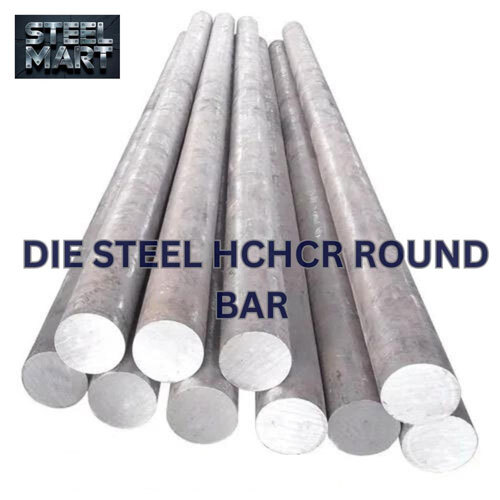
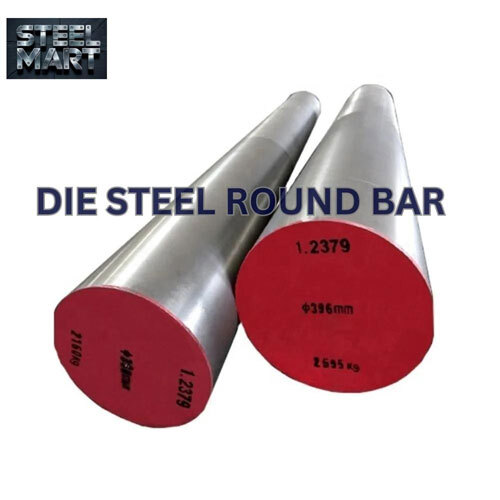
About Die Steel HCHCR Round Bar
Steel World is stockiest, supplier,dealer and manufacturer of the Die Steel HCHCR Round Bar.HCHCR Die Steel, also known as D3 steel (1.2080/X210Cr12), is a high-carbon, high-chromium cold-work tool steel. Lets explore its key features:
-
Composition:
- Carbon : 2.00% - 2.35%
- Chromium (Cr): 11.00% - 13.50%
- Silicon (Si): 0.60%
- Manganese (Mn): 0.60%
- Nickel (Ni): 0.30%
- Vanadium (V): 1.00%
- Copper (Cu): 0.02%
- Tungsten (W): 1.00%
-
Properties:
- Hardness: HCHCR D3 steel achieves a hardness in the range of 58-64 HRC after proper heat treatment.
- Wear Resistance: Excellent abrasion/wear resistance.
- Applications: Ideal for highly stressed cutting tools, punching tools for thin sheets, shear blades for cutting, profile rolls, drawing and deep drawing tools, stone processing tools, knives for paper and plastics, and shear knives for thin sheets.
-
Heat Treatment:
- Hardening: It is preferable to heat the tools in a controlled atmosphere. If this is not possible, pack hardening is recommended. Preheat the component to 750-800C and allow it to soak at this temperature. Raise to the hardening temperature of 950-980C. Soak thoroughly at the temperature for thirty minutes per 25mm of ruling section, then cool or quench accordingly.
- Tempering: Double tempering is recommended. Tempering should be done with the least possible delay after hardening, preferably when the tools are still hand warm. Select a suitable tempering temperature, bearing in mind the service requirements.
Optimized Wear and Crack ResistanceEngineered with a robust microstructure featuring uniformly distributed carbides, the Die Steel HCHCR Round Bar excels in environments requiring extraordinary wear and crack resistance. Its even grain surface ensures operational reliability and reduces the risk of surface deformities, making it a dependable choice for tool and die makers.
Consistent Machinability and PrecisionModerate machinability, combined with tight cutting tolerances and an annealed delivery state, enables efficient processing and high-precision component fabrication. This balance means reduced tool wear and increased productivity without compromising the structural integrity or performance of the bar.
FAQ's of Die Steel HCHCR Round Bar:
Q: How is the Die Steel HCHCR Round Bar typically used in industry?
A: Die Steel HCHCR Round Bars are used for manufacturing high-performance dies, punches, and cutting tools. Their high wear resistance and crack resistance make them ideal for both cold and hot work applications in automotive, fabrication, and general engineering sectors.
Q: What benefits does the annealed delivery condition offer?
A: The annealed delivery condition enhances machinability by reducing internal stresses, making cutting and shaping easier without sacrificing toughness. This provides an ideal starting point for precision machining or further heat treatment.
Q: When should I choose the HCHCR round bar with tight cutting tolerance?
A: Selecting an HCHCR round bar with tight cutting tolerance is recommended when your application demands components with precise dimensions and minimal post-machining. This reduces material waste and ensures a secure fit in assembly processes.
Q: Where can I source Die Steel HCHCR Round Bars in India?
A: Die Steel HCHCR Round Bars are widely available through dealers, distributors, exporters, importers, manufacturers, suppliers, traders, wholesalers, and retailers across India. Choose an authorized source to ensure standardized quality and availability.
Q: What are the advantages of the distributed carbide microstructure?
A: A distributed carbide microstructure provides enhanced wear resistance, improved toughness, and evenly balanced mechanical properties. This makes the steel more durable in abrasive environments and less susceptible to crack initiation.
Q: How does the production technique affect the bar's performance?
A: Production by hot rolling or forging results in a refined grain structure, which contributes to uniform mechanical properties and reliable performance under mechanical stress. This technique also ensures the edge remains smooth and the surface grain even.




 Send Inquiry


 Send Inquiry
 Send Inquiry